
Getting consistent color across hues is still one of the trickiest parts of professional grading. Math-based color models do not always match how we see color, and that disconnect shows up fast when precision matters. You can dial in a perfect RGB value, but if it does not feel right to the eye, it is not right. Understanding perceptual color spaces is what bridges that gap.
A Brief History: From CIE 1931 to CIELAB
In 1931, the CIE (International Commission on Illumination) published the first official model of human color vision the CIE 1931 color space. It was a landmark achievement: translating visible light into numbers for the first time. But it was not perceptually uniform. Equal numerical changes did not produce equal perceptual changes. A shift of the same mathematical magnitude in two different parts of the color space could look dramatically different to the human eye.
Later models, including CIELAB (based on Richard S. Hunter’s 1948 L,a,b model and officially standardized in 1976), aimed to fix this. The goal was a space where a numerical shift meant an equal visual shift where the math tracked with human perception rather than abstract light physics.
Why HSL Falls Short
HSL is ubiquitous in software interfaces because it is intuitive and easy to use. But perceptually, it misleads. The L in HSL is not true lightness it is the average of the highest and lowest RGB values, ignoring the middle channel entirely. This is why pure blue and cyan can have the same HSL lightness value while looking dramatically different to the eye. One clearly pops more than the other.
This makes HSL frustrating for serious color work. Boost saturation and the image may appear lighter or darker even if the L value has not changed. It is not just inconvenient it is misleading in ways that compound over a full grade.
When CIELAB Comes In Handy
CIELAB is not perfect it is not truly perceptually uniform across all conditions but it is substantially closer, and that margin matters in professional work. CIELAB is device-independent, built on the CIE standard observer rather than any specific display’s rendering behavior. This means better consistency across OLED, P3 cinema, and streaming platforms critical for any project finishing for multiple deliverables.
In practical grading terms, CIELAB helps detect small color differences, keep hues consistent while pushing or pulling image regions, and maintain accuracy across skin tones, fabrics, and skies all areas where tiny shifts can break the image in ways that are immediately visible to trained and untrained eyes alike.
Newer Models: HSLuv and the Direction of Travel
Tools like HSLuv take the familiar HSL layout and hook it to the perceptual strengths of CIELUV giving colorists something intuitive to use without the problematic lightness behavior. It is not industry standard yet, but it represents the direction the field is moving: toward interfaces that respect the gap between mathematical and perceptual color.
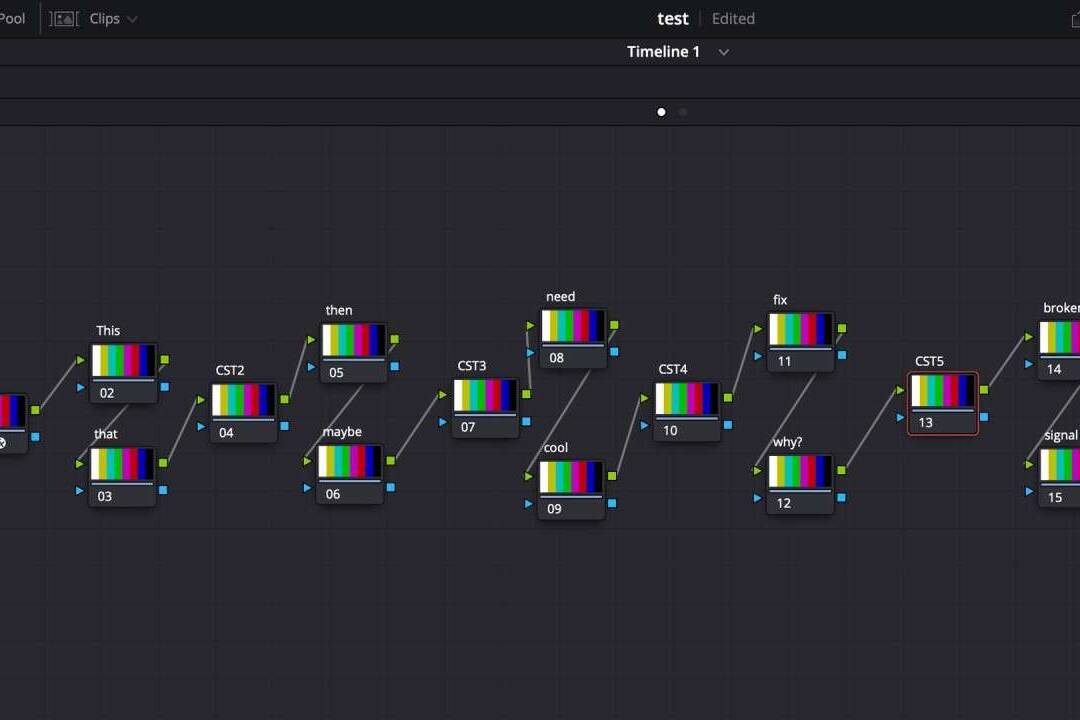
Modern grading software, including DaVinci Resolve and Baselight, increasingly offers access to perceptual spaces. For workflow context on how color space decisions affect your pipeline more broadly, see Color Space Transforms in DaVinci Resolve: How Many Is Too Many?
Related Reading from Final Stage Post House
- Color Temperature and Contrast: Moving Beyond Continuity
- Exploring Synergies: The Parallels Between Film and Tape
- What We Couldn’t Find, We Built Ourselves: The Spectra Toolbox (coming soon)
Frequently Asked Questions
Do I need to work in CIELAB to grade professionally?
Not necessarily. Most professional grades are done in log or scene-referred spaces with Rec.709 or P3 ODTs. But understanding perceptual models helps you make better decisions when HSL tools behave unexpectedly and knowing when to reach for a LAB-based tool rather than an HSL one is a meaningful skill upgrade.
What is a perceptually uniform color space?
A color space where equal numerical changes in any direction produce equal perceived changes in color. In a truly perceptually uniform space, every step feels the same size to the human eye. CIELAB approximates this better than RGB or HSL, though no model achieves it perfectly.
How does device independence in CIELAB help real-world delivery?
Because CIELAB is built on a standardized model of human vision rather than a specific display’s gamut, it provides a stable reference point for comparing color across different output devices SDR TV, P3 cinema, OLED mobile without the inconsistencies that arise from device-dependent RGB spaces.
Source: Understanding Perceptual Color Spaces – Rodrigo Perez-Segnini on LinkedIn
Working on a project where color accuracy across platforms matters? Connect with Final Stage Post House.

Related Posts
June 18, 2026
You Locked the Picture. Now What? A Practical Audio Post Guide
Picture lock isn't the finish lineâit's the starting gun for audio post.…

June 18, 2026
Color Space Transforms in DaVinci Resolve: How Many Is Too Many?
Stack too many CSTs in DaVinci Resolve and you risk banding, hue shifts, and…

June 18, 2026
The Frequencies That Shape Our Perception
Light and sound are both waveforms processed by biology. Understanding how we…